
Disaster Recovery Is Not a Backup Strategy Alone
Disaster recovery is more than maintaining regular data backups. It is about ensuring that critical systems, applications, infrastructure, and business operations can be restored within acceptable timeframes when unexpected disruptions occur. A resilient organization prepares not just to protect its data, but to keep its business running.
· 5 min read
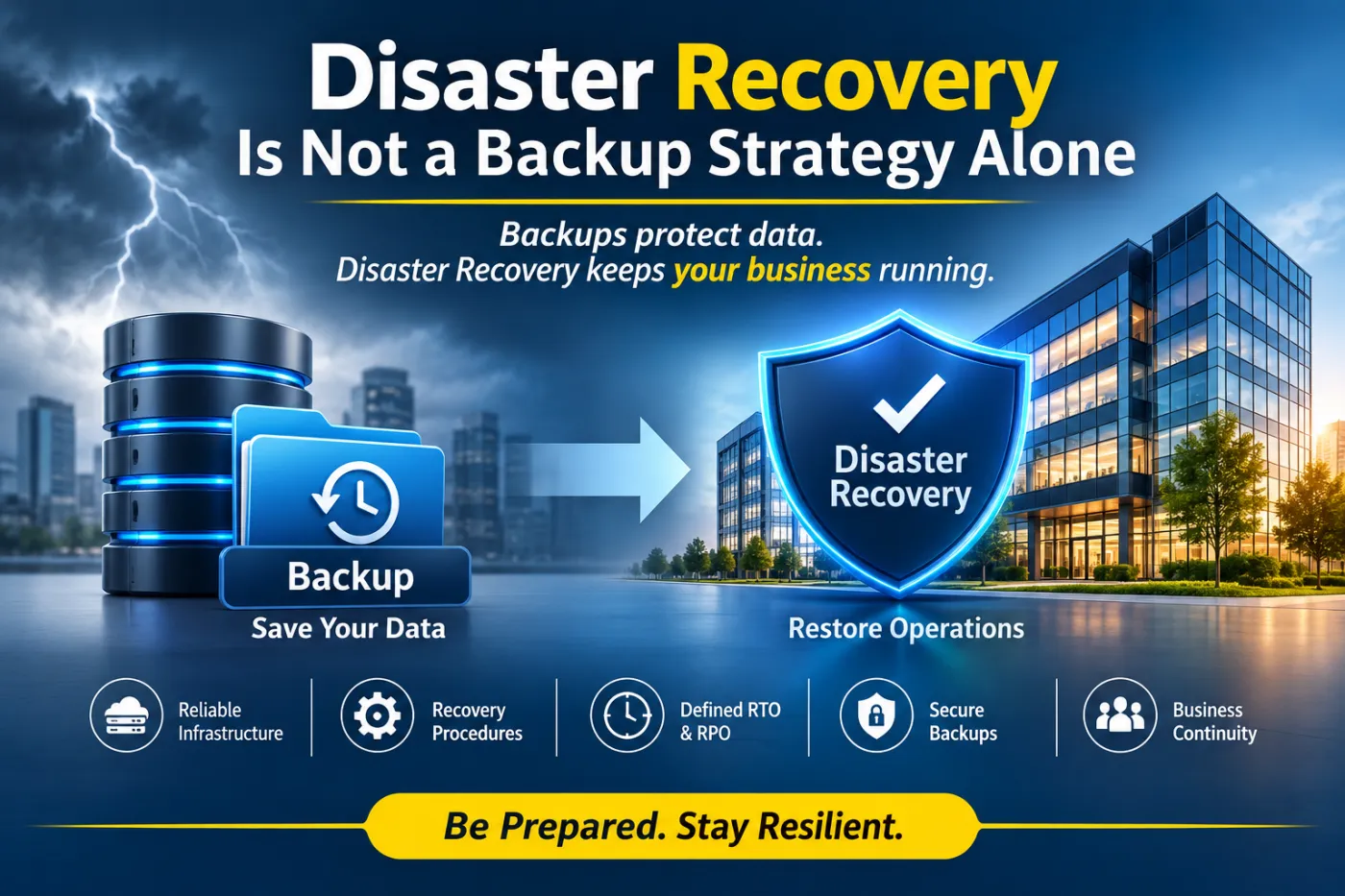
In today's technology-driven business environment, data is one of an organization's most valuable assets. From financial transactions and enterprise applications to customer information and operational records, businesses depend on technology to maintain continuity and deliver services. However, protecting data through regular backups does not automatically mean an organization is prepared for a disaster.
Disaster recovery is much more than backing up data. It is about ensuring that the entire business can continue operating when critical technology, infrastructure, or systems become unavailable.
Many organizations invest in backup solutions, cloud storage, and redundant hardware, believing these measures are sufficient to protect them from unexpected disruptions. While these investments are essential, they represent only one part of a comprehensive disaster recovery strategy.
A backup can help recover lost data, but it cannot independently restore an entire business operation.
Understanding the Difference Between Backup and Disaster Recovery
Backup focuses primarily on creating copies of data so that information can be restored when it is lost, corrupted, or accidentally deleted.
Disaster recovery, on the other hand, focuses on restoring the technology environment and critical business services within an acceptable timeframe after a major disruption.
A comprehensive disaster recovery strategy considers several critical components:
-
Infrastructure recovery: Restoring servers, networks, storage, firewalls, and other essential IT infrastructure.
-
Application recovery: Ensuring ERP systems, databases, business applications, and integrations become operational again.
-
Data recovery: Restoring accurate, consistent, and reliable data from protected backup sources.
-
Network connectivity: Establishing secure connectivity between business locations, data centers, remote users, and cloud environments.
-
People and responsibilities: Defining who makes decisions, who executes recovery activities, and how teams coordinate during an incident.
-
Business continuity: Ensuring critical business processes continue with minimal disruption while IT services are being restored.
The Hidden Risks of a Backup-Only Approach
Imagine an organization that performs daily backups of its ERP database. One day, its primary data center becomes unavailable due to hardware failure, ransomware, fire, or a major power disruption.
The organization has its backups, but several questions immediately arise:
-
Where will the systems be restored?
-
Are standby servers and storage available?
-
How long will infrastructure provisioning take?
-
Are application configurations and encryption keys protected?
-
Can users access the restored systems?
-
Are integrations with other business applications working?
-
Has the recovery process ever been tested?
Having a backup does not guarantee that the organization can answer these questions.
An untested backup may be incomplete, corrupted, outdated, or incompatible with the recovery environment. Even when data is successfully restored, the business may remain unable to operate because applications, networks, dependencies, and supporting services are unavailable.
Building a Resilient Disaster Recovery Framework
An effective disaster recovery framework should be designed around business requirements rather than technology alone.
1. Identify Critical Business Services
Start by identifying the business processes and technology services that are essential for daily operations. Finance, payroll, procurement, sales, inventory, and customer services may have different recovery priorities.
2. Define RTO and RPO
Two important metrics should guide every disaster recovery strategy:
-
Recovery Time Objective (RTO): The maximum acceptable time required to restore a service after disruption.
-
Recovery Point Objective (RPO): The maximum acceptable amount of data loss measured in time.
These objectives should be defined according to business impact, operational priorities, and financial considerations.
3. Establish a Reliable Disaster Recovery Environment
A secondary data center, cloud-based recovery infrastructure, or hybrid DR environment can provide an alternative operating platform when the primary environment fails.
However, having a DR site is not enough. It must have adequate computing capacity, storage, network connectivity, security controls, and documented recovery procedures.
4. Protect Backups Against Cyber Threats
Modern ransomware attacks increasingly target backup repositories to prevent organizations from recovering their data.
Organizations should consider immutable backups, offline copies, access restrictions, encryption, multi-factor authentication, and separate administrative credentials to strengthen backup protection.
5. Document Recovery Procedures
A disaster recovery plan should clearly document recovery sequences, technical dependencies, escalation procedures, responsibilities, communication channels, and business priorities.
The document should be practical enough for the IT team to execute during a high-pressure situation.
6. Test, Review, and Improve Regularly
A disaster recovery plan that exists only in documentation provides limited assurance.
Organizations should conduct periodic recovery tests, application failover exercises, backup restoration tests, and full DR simulations. Lessons learned from these exercises should be incorporated into the recovery plan.
Disaster Recovery Is a Business Responsibility
One of the biggest misconceptions is that disaster recovery belongs exclusively to the IT department.
IT teams are responsible for designing and implementing technical recovery capabilities, but business leaders must determine which operations are critical, how much downtime is acceptable, and what level of investment is justified.
Effective disaster recovery requires collaboration between IT, finance, operations, HR, senior management, and external technology partners.
It is not simply an infrastructure project. It is an organizational commitment to resilience.
Final Thoughts
Technology failures, cyberattacks, natural disasters, and human errors are not always predictable. What organizations can control is how prepared they are to respond when these events occur.
Backups help protect data. Disaster recovery restores technology. Business continuity protects the organization.
A mature organization does not measure its disaster recovery readiness by how frequently it takes backups or whether it owns a secondary data center. It measures readiness by how confidently it can restore critical services, protect business operations, and recover within agreed business expectations.
Ultimately, the real test of disaster recovery is not whether an organization has a backup when disaster strikes. It is whether the organization can continue doing business when its primary technology environment is no longer available.
- ITLeadership
- ITGovernance
- Cybersecurity
- RiskManagement
- DisasterRecovery
- BusinessContinuity
- DataProtection
- ITInfrastructure
- DigitalResilience
Share
Keep reading
Related articles
· 1 min read
Having a Backup Does Not Mean You Are Ready for a Disaster
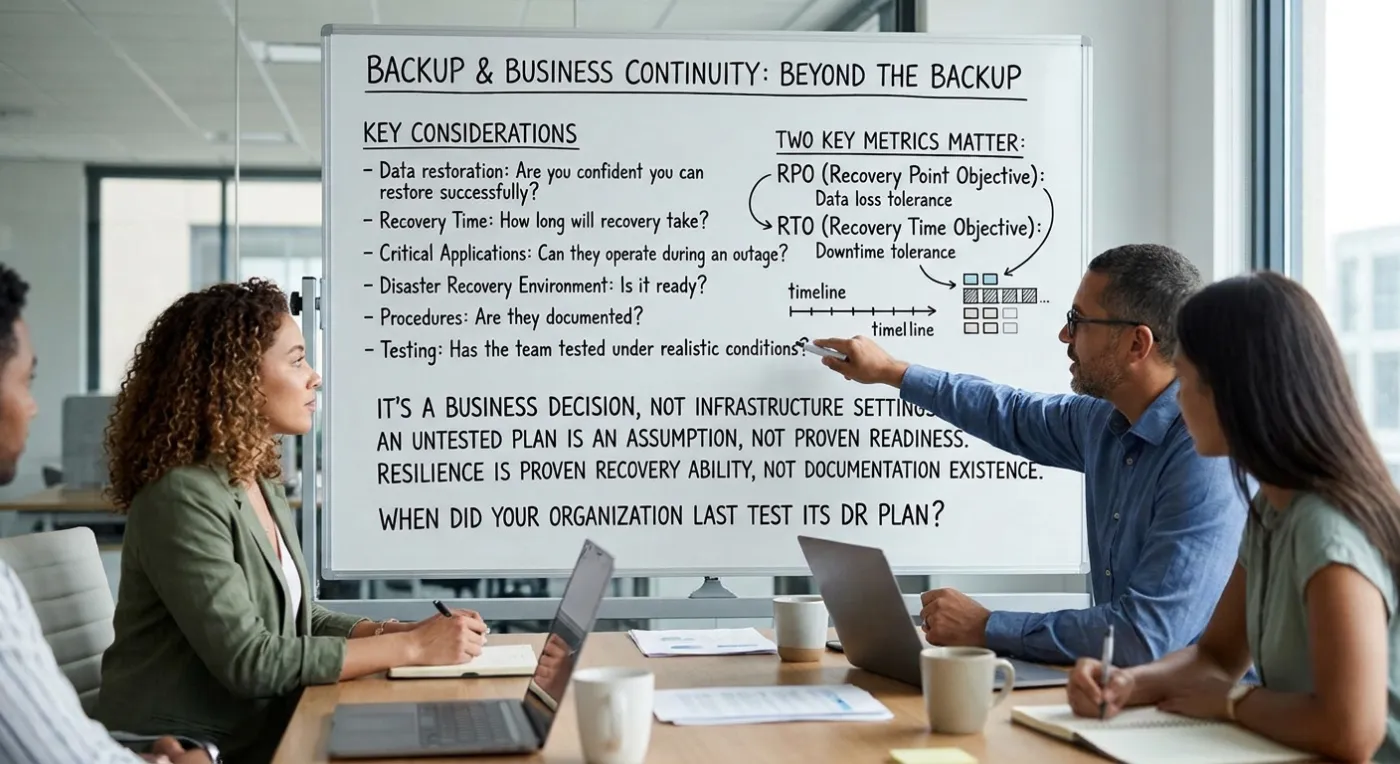
Business continuity demands far more than routine backups; it requires a validated strategy for total operational resilience. Backups preserve data, but disaster recovery depends on your ability to restore systems and keep critical applications running during an outage. This relies on defining two key business metrics: Recovery Point Objective (RPO), which measures tolerable data loss, and Recovery Time Objective (RTO), which limits acceptable downtime. An untested plan is just an assumption. Resilience is measured not by documented procedures, but by proven recovery capabilities.
Cybersecurity & Governance

· 2 min read
Why Access Reviews Matter More Than People Think?
Many organisations invest heavily in advanced cybersecurity tools, yet they frequently overlook one of the simplest security controls: regular access reviews. Over time, as employees shift roles and external contractors conclude their work, unmonitored privileges accumulate, leaving dormant or excessive permissions open. Technology and identity management systems alone cannot mitigate this risk; proactive governance is essential to constantly evaluate not just who holds access, but whether that access remains appropriate.
Cybersecurity & Governance
· 1 min read
An Audit-Ready Organization Is Built Every Day, Not One Week Before the Audit
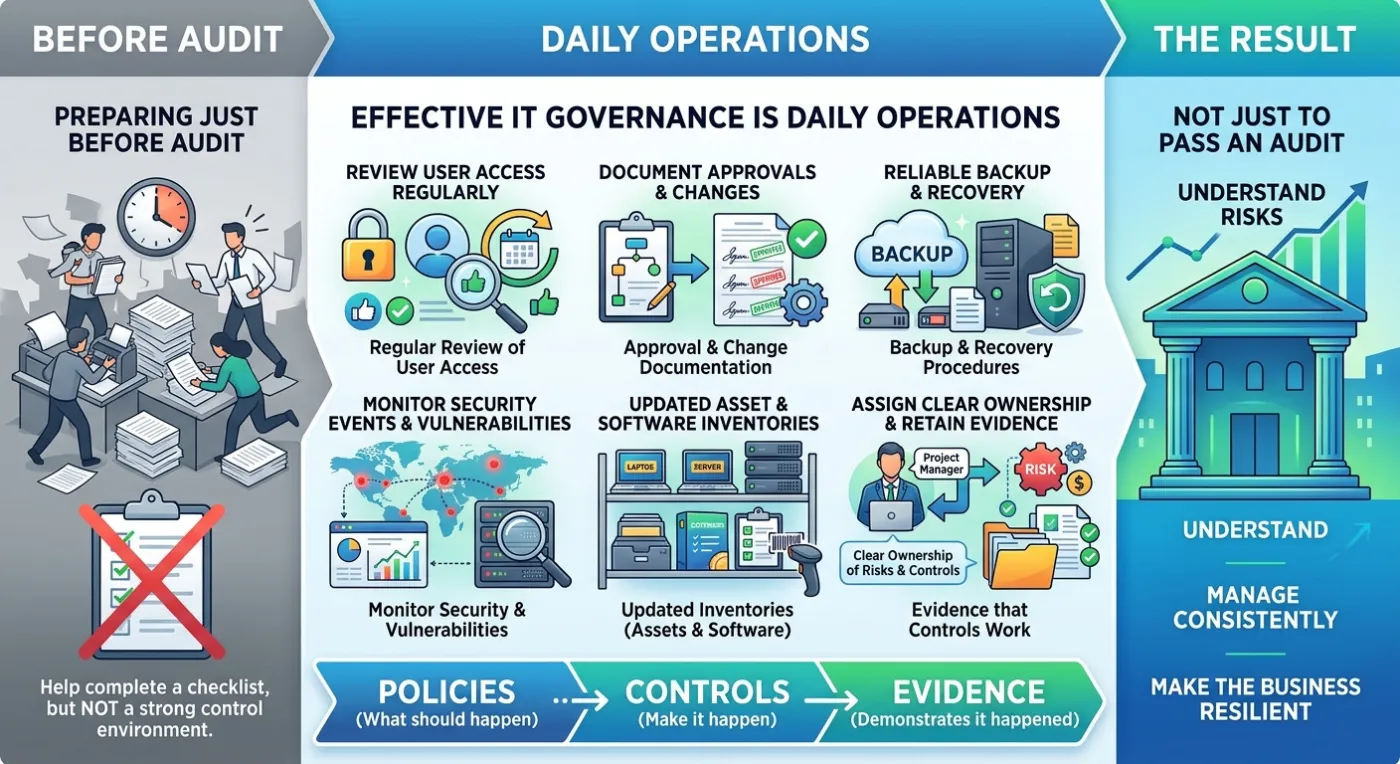
Effective IT governance is woven into the fabric of daily operations rather than assembled in a frantic scramble right before an audit. True control environments are built through consistent practices—such as regular user access reviews, meticulous approval documentation, reliable backup procedures, and clear risk ownership—transforming governance from a compliance checklist into an engine for operational resilience.
Cybersecurity & Governance